
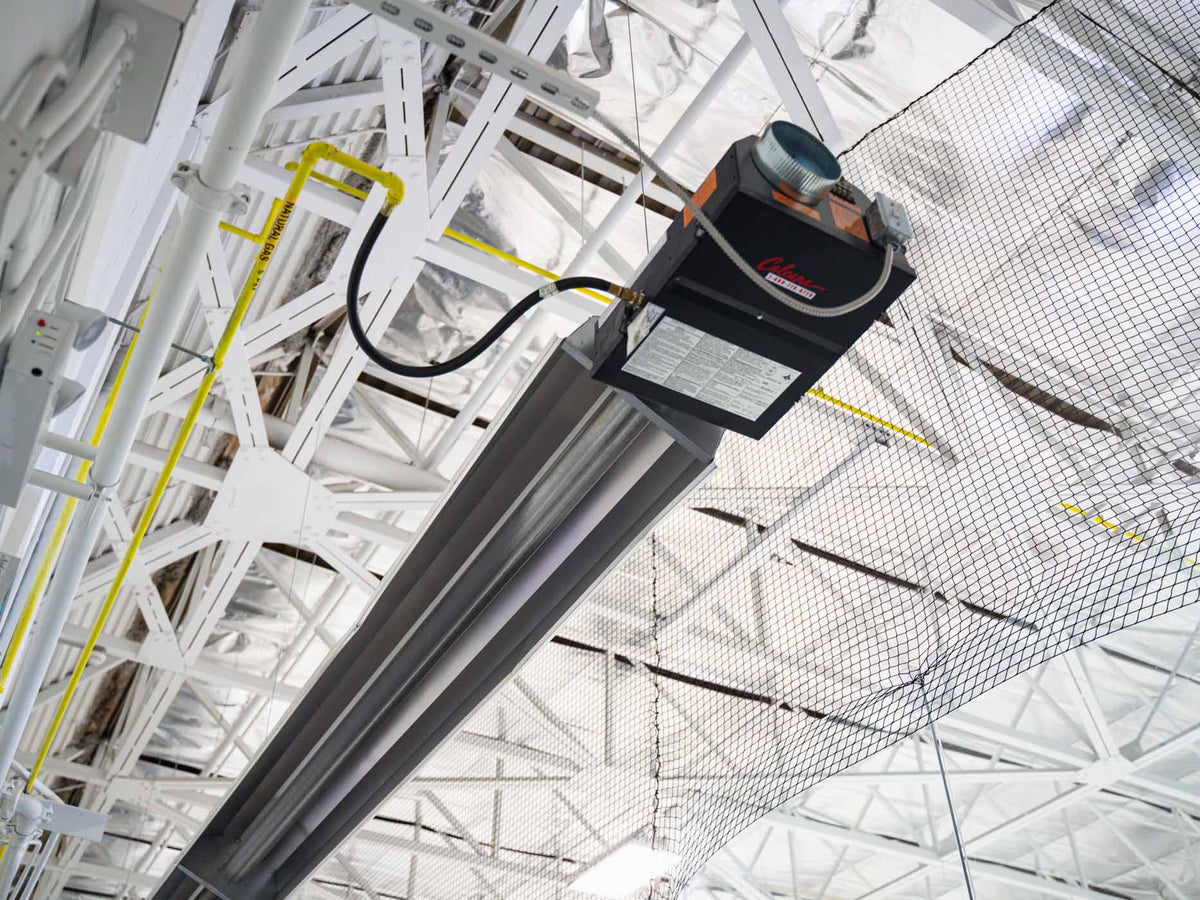
Heating a large industrial facility comes with challenges that simply do not exist in smaller spaces. Warehouses, manufacturing plants, aircraft hangars, agricultural buildings, service bays, and other large facilities can have high ceilings, expansive floor plans, large overhead doors, and areas that are difficult to heat consistently.
Traditional forced-air heating systems can struggle in these environments because they primarily rely on heating and circulating air throughout the building. In a large, open facility, warm air can rise toward the ceiling, escape through frequently opened doors, or become difficult to maintain in areas with significant air movement.
This is where infrared heating offers a different approach.
Calcana's SR Series industrial infrared heaters are gas-fired radiant heating systems designed specifically for large commercial and industrial spaces. Instead of relying primarily on heated air to deliver warmth, the SR Series directs infrared energy toward people, floors, equipment, vehicles, work areas, and other surfaces within the heating zone.
The result is targeted, comfortable heat designed around the way large industrial spaces are actually used.
With inputs ranging from 40,000 to 200,000 BTUs per hour, natural gas or propane options, flexible mounting configurations, rugged construction, and features designed for demanding environments, the SR Series is built to handle applications where dependable heating performance matters.
What Is the Calcana SR Series? An Overview of Industrial Infrared Heaters for Large Commercial & Industrial Spaces
The SR Series is Calcana's line of industrial infrared heaters designed for large-scale commercial, industrial, agricultural, and other demanding applications.
These gas-fired heaters are intended for spaces where traditional heating methods can have difficulty delivering comfortable conditions efficiently. Rather than attempting to heat the entire volume of air equally, the SR Series uses radiant energy to directly warm objects and surfaces within its coverage area.
This makes the technology particularly useful for facilities with high ceilings or large open floor plans.
A warehouse, for example, may have significant amounts of unused space above the areas where employees actually work. Heating all of that air can be challenging and may not provide the most targeted approach to employee comfort.
Infrared heating allows the system to focus energy toward the occupied portion of the building.
The SR Series is available with input capacities ranging from 40,000 to 200,000 BTUs per hour, allowing systems to be selected according to the size, layout, and heating requirements of a facility. Models are available for both natural gas and propane applications.
How Does Industrial Infrared Heating Work?
Understanding the SR Series starts with understanding radiant heat.
A conventional forced-air heating system heats air and then distributes that air throughout a building. Fans, ductwork, and air movement are typically used to move the heat from the heating equipment to the occupied areas.
Infrared heating works differently.
An infrared heater emits radiant energy that travels outward from the heating element. When that energy reaches people, floors, vehicles, machinery, workbenches, equipment, and other objects, those surfaces absorb the energy and become warmer.
This means the system does not have to rely entirely on maintaining a large volume of heated air.
That distinction can be especially important in industrial facilities.
High ceilings can allow heated air to accumulate overhead, while large doors can introduce cold outdoor air whenever they are opened. An infrared system can instead be positioned to direct heat toward the areas where employees and equipment actually need it.
The objective is not simply to make the air above the facility warm. It is to create useful, comfortable heating at the working level.
Designed for Large, Open Spaces
Industrial facilities often have very different heating requirements than offices or residential buildings.
A warehouse may have a ceiling that is several metres above the floor. A manufacturing facility may have large pieces of equipment occupying most of the floor. An aircraft hangar can contain an enormous open volume. Agricultural buildings may have significant air movement and changing environmental conditions.
These spaces can make conventional heating particularly challenging.
The SR Series is designed for these large-scale environments, providing powerful infrared output that can be distributed strategically throughout the facility.
Instead of relying on a single central heating source to warm the entire building, multiple infrared heaters can be positioned to create heating zones throughout the occupied areas.
This approach allows the heating system to be designed around the facility's actual layout.
Workstations, production lines, loading areas, maintenance bays, storage areas, and employee zones can all be considered when determining heater placement.
Powerful Heating Output
Large industrial spaces require serious heating capacity.
The SR Series offers input options ranging from 40,000 to 200,000 BTUs per hour, providing a broad range of heating capabilities for different applications.
The appropriate output depends on far more than the square footage of a building.
Ceiling height, insulation, building construction, outdoor climate, number and size of doors, ventilation requirements, desired indoor conditions, and the way the space is used can all affect heating requirements.
This is why choosing an industrial heater should not simply come down to selecting the largest available unit.
Proper sizing and layout are important for creating effective coverage. A heating professional can evaluate the facility and determine the appropriate number, capacity, and placement of heaters.
2-Stage & Modulating Output Options
Industrial facilities do not always have the same heating requirements throughout the day.
Outdoor temperatures change. Garage doors open and close. Occupancy levels fluctuate. Production areas may operate on different schedules, and some sections of a facility may require more heat than others.
The SR Series offers 2-stage and modulating output options, depending on configuration, allowing heating performance to respond to changing conditions.
Modulation can be particularly useful because the heater does not necessarily need to operate at maximum output whenever heat is required.
Instead, output can be adjusted according to the current heating demand.
This provides greater control over the environment and can help avoid the unnecessary operation associated with simply running a heater at full capacity whenever it is turned on.
For large facilities, that flexibility can be an important part of creating a comfortable and efficient heating strategy.
High-Efficiency Operation
One of the primary reasons industrial facilities consider infrared heating is efficiency.
Calcana states that its SR Series can consume up to 40% less fuel than conventional forced-air units.
The technology's targeted approach is an important part of this equation.
Rather than concentrating solely on heating the air throughout the entire building, radiant heat is directed toward surfaces and occupied areas. This can be particularly advantageous in buildings where high ceilings and large open volumes make air-based heating more challenging.
The actual energy consumption and savings of any heating system will depend on the building, climate, controls, operating schedule, insulation, heater layout, and other factors.
However, the ability to direct heat where it is needed gives industrial facilities another way to approach their heating requirements.
The SR Series 8-Sided Reflector
One of the defining features of the SR Series is its heavy-duty 8-sided reflector.
Calcana describes the reflector as one of the industry's largest and strongest 8-sided reflector designs, engineered for heat distribution, structural strength, and reduced operational noise.
The reflector plays an important role in directing infrared energy toward the intended heating area.
Its design also contributes to the rugged construction required for industrial environments.
In a facility where equipment operates for long periods and heating systems need to withstand demanding conditions, construction quality matters. The heater needs to perform reliably while maintaining the structural integrity of its components.
The SR Series reflector is designed with these considerations in mind.
Built for Harsh Industrial Environments
Industrial heating equipment needs to be more than powerful.
It needs to be durable.
Warehouses, manufacturing facilities, agricultural buildings, service areas, and other industrial environments can expose heating equipment to dust, changing temperatures, moisture, equipment movement, and other demanding conditions.
The SR Series includes four harsh-environment options with stainless-steel construction, allowing configurations to be selected for demanding applications. Calcana also states that the SR Series is certified for use down to -40°F in indoor or outdoor environments.
This makes the SR Series particularly relevant for facilities that need heating equipment capable of operating in challenging climates.
For Canadian businesses and other operations exposed to cold winter temperatures, equipment designed with harsh conditions in mind can provide an important level of confidence.
Durable Construction for Long-Term Use
Industrial heaters are a long-term investment.
When heating equipment is installed in a large facility, replacing or extensively modifying the system can be disruptive and expensive. Reliability and durability therefore become important considerations alongside initial heating capacity.
The SR Series is designed with features intended to support long-term operation, including anti-warp reflectors, anti-walk design, and corrosion-resistant materials.
These details may not be the first thing a facility manager considers when comparing heaters, but they can have a significant impact over time.
Industrial equipment needs to withstand repeated heating cycles and the physical demands of its environment.
A rugged heating system can help support reliable operation while minimizing unnecessary downtime.
Flexible Mounting Options
Every industrial building is different.
Some facilities have exposed ceiling structures. Others have restricted mounting areas, equipment occupying certain portions of the ceiling, or workspaces that require heat to be directed from a particular angle.
The SR Series provides flexible installation options, including wall and ceiling mounting as well as horizontal or angled configurations. Multiple units can also be grouped together to provide scalable heating coverage across larger facilities.
This flexibility allows the heating system to be designed around the facility instead of forcing the facility to accommodate the heating equipment.
Mounting height and angle are important considerations because they influence the distribution of radiant heat.
The final configuration should always be determined according to the heater's specifications, installation requirements, applicable codes, and the layout of the facility.
Ideal for High-Ceiling Facilities
High ceilings are one of the most common challenges in industrial heating.
In a large facility, there can be a substantial amount of air between the working floor and the roof. With conventional heating, warm air can rise and collect near the ceiling, while employees working below may still experience cooler conditions.
Infrared heating approaches this differently.
Because radiant energy can travel from the heater toward the floor and objects below, the system does not depend entirely on maintaining heated air throughout the full vertical height of the building.
This makes infrared particularly attractive for warehouses, hangars, manufacturing plants, arenas, and other high-ceiling applications.
Instead of trying to make the entire building feel like a conventional office environment, the heating system can be designed to provide warmth where employees actually work.
Warehouses & Distribution Facilities
Warehouses are a natural application for industrial infrared heating.
They often combine high ceilings, large open floor plans, loading doors, vehicle traffic, storage racks, and areas that may not be continuously occupied.
The SR Series can be positioned to provide radiant heat across working zones, aisles, loading areas, and other occupied spaces.
This can be especially useful around loading docks, where large doors may open regularly and cold outdoor air can enter the building.
Rather than relying entirely on heated air remaining inside the facility, infrared heating provides a targeted source of radiant warmth.
Manufacturing Facilities
Manufacturing environments can have complex layouts and demanding heating requirements.
Production lines, machinery, workstations, assembly areas, maintenance zones, and storage areas may all occupy the same building.
The SR Series can be incorporated into a heating plan that considers these different zones.
This can help provide warmth around areas where employees spend significant amounts of time without requiring the heating system to treat every part of the facility identically.
For manufacturing businesses, maintaining comfortable working conditions can be an important part of creating a productive environment.
Aircraft Hangars & Large Service Facilities
Aircraft hangars and other large service facilities present some of the most challenging heating conditions.
Their enormous doors and expansive interiors can make maintaining comfortable air temperatures difficult.
Infrared heating can provide a targeted approach for these applications by directing radiant energy toward the floor-level areas where technicians and other employees are working.
The SR Series is designed for large open-space applications such as aircraft hangars, making it a strong option for facilities that need significant heating capacity and flexible coverage.
Agricultural Applications
Agricultural facilities can also benefit from industrial infrared heating.
Barns, agricultural buildings, equipment facilities, and other large structures can have high ceilings, large openings, and environmental conditions that make conventional heating difficult.
The SR Series is designed for agricultural applications and provides a way to deliver targeted radiant heat within large spaces.
As with any agricultural heating application, the specific installation needs to account for building construction, combustible materials, ventilation, clearance requirements, and the particular environmental conditions of the facility.
Service Bays & Automotive Facilities
Large automotive service facilities can also present challenging heating conditions.
Service bays often have overhead doors that are frequently opened and closed, high ceilings, concrete floors, and technicians working in specific areas for extended periods.
Infrared heating can provide targeted warmth to these work zones rather than relying exclusively on heated air to fill the entire building.
This can help create a more comfortable environment for technicians while keeping the heating strategy focused on the areas that are actually occupied.
The SR Series is designed for applications including service bays and other large commercial spaces.
Quiet, Draft-Free Comfort
Another advantage of infrared heating is the way it delivers warmth.
Because radiant heating does not require a fan to distribute heated air throughout the space, the SR Series can provide quiet, draft-free heating.
This can be valuable in industrial environments where employees are already surrounded by machinery, tools, compressors, vehicles, and other sources of noise.
Reducing unnecessary air movement can also make the environment more comfortable for employees working directly beneath or around the heating system.
Instead of feeling a constant stream of warm air moving through the facility, employees experience radiant warmth directed toward the occupied area.
No Exposed Flame or Pilot Light
The SR Series uses an enclosed burner system with electronic three-try direct spark ignition, rather than a traditional exposed flame or pilot light.
This design is part of Calcana's approach to providing industrial heating equipment that is engineered for demanding applications.
As with any gas-fired heating equipment, proper installation, ventilation, clearances, gas connections, and adherence to applicable codes are essential.
The specific requirements will depend on the heater configuration and installation environment.
Low Maintenance Design
Industrial facilities need heating systems that are practical to maintain.
When equipment is installed overhead, routine servicing needs to be straightforward so maintenance teams can inspect and service the heater without unnecessary downtime.
The SR Series features an accessible burner compartment and tool-free servicing designed to simplify maintenance.
Regular maintenance is still essential.
Cleaning, inspections, combustion checks, gas connections, controls, and other components should be addressed according to the manufacturer's requirements and the conditions of the installation.
Keeping industrial heating equipment properly maintained can help support safe, reliable performance throughout the heating season.
Planning the Right Number of SR Series Heaters
Large facilities often require more than one heater.
Instead of attempting to heat an entire building from one location, multiple SR Series units can be positioned throughout the facility to create overlapping heating zones.
The number of heaters required depends on the building's dimensions, insulation, ceiling height, climate, desired comfort level, mounting arrangement, and heat-loss characteristics.
The layout of equipment and work areas should also be considered.
For example, a manufacturing facility may need concentrated heating along production lines, while a warehouse may benefit from strategically spaced units throughout its occupied areas.
Proper heater placement can be just as important as heater output.
Installation & Safety Considerations
Industrial infrared heaters need to be installed correctly.
Mounting location, clearances to combustible materials, gas supply, ventilation, flue requirements, electrical connections, controls, and other installation factors need to be considered before a system is installed.
The SR Series is designed with low clearance-to-combustible requirements and flexible mounting options, but the exact requirements depend on the model and installation configuration.
Installation should always follow the manufacturer's instructions and applicable local building, gas, electrical, and safety codes.
For large commercial and industrial facilities, working with qualified professionals can help ensure the heating system is properly sized, positioned, installed, and commissioned.
Why Choose the SR Series for Industrial Heating?
Industrial heating is not simply about producing more BTUs.
A successful system needs to deliver heat where it is needed, operate reliably in the conditions of the facility, accommodate the building's layout, and provide practical control over changing heating demands.
The SR Series brings these considerations together through gas-fired infrared technology, high output capacities, rugged construction, flexible mounting options, adjustable output options, and designs intended for demanding industrial environments.
It is a heating solution designed around large spaces rather than adapted from smaller applications.
Whether the facility is a warehouse, manufacturing plant, aircraft hangar, agricultural building, automotive service facility, or another large commercial environment, the SR Series provides a scalable approach to industrial radiant heating.
A Powerful Heating Solution for Large Industrial Spaces
Large industrial buildings require a different approach to heating.
High ceilings, large doors, expansive floor plans, equipment, changing occupancy, and challenging environmental conditions can all make conventional heating difficult to manage.
Calcana's SR Series industrial infrared heaters are designed to address these challenges by delivering targeted radiant warmth to the people, equipment, floors, and work areas that need it most.
With heating inputs from 40,000 to 200,000 BTUs per hour, natural gas and propane options, flexible mounting configurations, 2-stage and modulating output options, rugged reflector construction, harsh-environment configurations, and low-maintenance features, the SR Series is built for demanding applications.
The key is understanding that industrial infrared heating is not simply about heating the air faster.
It is about delivering heat differently.
By directing radiant energy toward occupied areas and surfaces, an infrared heating system can help facilities create more targeted and comfortable working environments without depending entirely on the movement and retention of heated air.
For businesses operating large facilities, that can make a meaningful difference in comfort, heating strategy, and day-to-day operations.
If you're evaluating heating options for a warehouse, manufacturing plant, aircraft hangar, agricultural building, service facility, or another large industrial space, the Calcana SR Series is designed to provide the power, flexibility, and durability needed for demanding environments.

Leave a comment
This site is protected by hCaptcha and the hCaptcha Privacy Policy and Terms of Service apply.