

Heating systems can dramatically improve the comfort and usability of outdoor patios, garages, warehouses, restaurants, and commercial workspaces. However, before installing any heating equipment, homeowners and business owners often ask an important question: do infrared heaters need ducting or special ventilation?
The answer depends on the type of infrared heater being used, the environment it operates in, and how the system is installed. Unlike traditional forced-air heating systems that rely heavily on ductwork to distribute warm air throughout a building, infrared heaters operate very differently. Instead of heating the surrounding air first, infrared systems transfer radiant heat directly to people, surfaces, and objects within the space.
Because of this unique heating method, many infrared heaters eliminate the need for bulky ducting systems altogether. This makes them especially attractive for outdoor patios, warehouses, garages, restaurants, and open commercial environments where installing traditional ductwork would be expensive, impractical, or inefficient.
At the same time, ventilation considerations still matter. Certain gas-powered infrared heaters require proper airflow and professional installation practices to maintain safe operation. Understanding how these systems work helps property owners choose the right heating setup while ensuring both safety and efficiency.
Understanding How Infrared Heaters Operate & Why They Don’t Require Traditional Ducted Heating Systems
To understand why infrared heaters often do not require ducting, it helps to first understand how they produce heat.
Traditional heating systems operate through convection. These systems warm the surrounding air and then circulate that heated air through vents, blowers, or ductwork. The warm air eventually raises the temperature of the room over time.
Infrared heaters work differently. Instead of heating the air itself, infrared systems emit radiant energy that travels through the air and warms solid objects directly. Floors, furniture, equipment, walls, and people absorb this radiant energy and convert it into warmth.
This process closely resembles the way sunlight warms the Earth. Even on a cool day, direct sunlight can make surfaces feel warm because radiant energy transfers heat without needing to warm the surrounding air first.
Since infrared systems do not rely on moving heated air throughout a building, they do not need traditional ducting systems to distribute warmth.
Why Traditional Heating Systems Require Ductwork
Forced-air heating systems depend heavily on ductwork because the heated air must travel from the furnace to different areas of the building.
This requires an extensive network of ducts hidden within ceilings, walls, crawlspaces, or mechanical rooms. Fans and blowers continuously push warm air through the system while return vents cycle cooler air back to the furnace for reheating.
In residential homes, this setup works reasonably well because the rooms are enclosed and insulated. However, in large open spaces, garages, patios, warehouses, and outdoor environments, ducted systems often struggle with efficiency.
Warm air naturally rises, which means much of the heat accumulates near the ceiling instead of remaining where people actually need it. In spaces with high ceilings or frequent door openings, significant heat loss can occur.
Infrared heating avoids many of these inefficiencies by eliminating the need to circulate heated air altogether.
Infrared Heaters Eliminate the Need for Ducting
One of the biggest advantages of infrared heating systems is their ability to operate without complex duct infrastructure.
Since infrared heaters project radiant warmth directly into the occupied area, there is no need for large ventilation ducts, air handlers, or centralized airflow systems. This simplifies installation considerably while reducing construction costs and maintenance requirements.
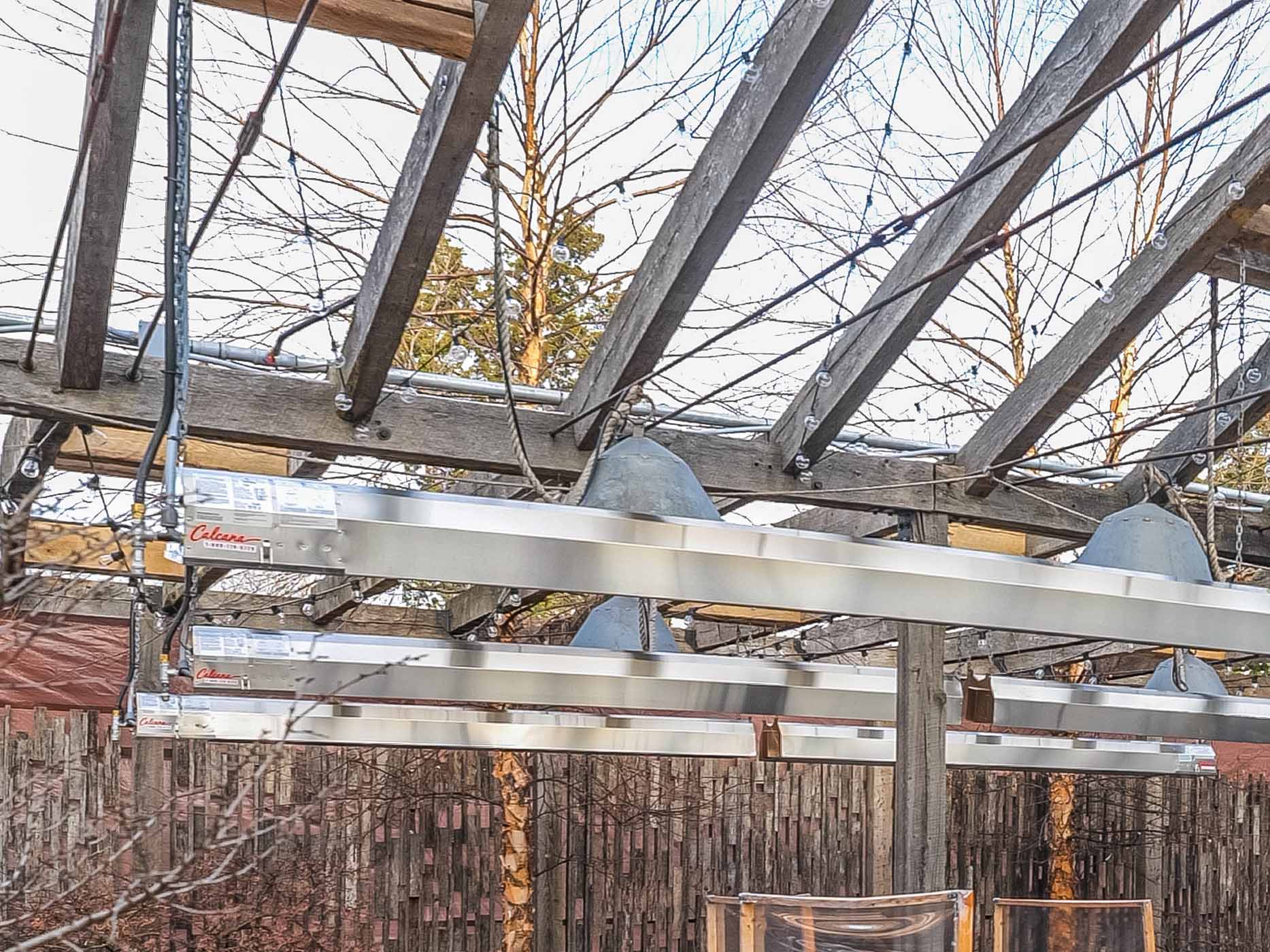
For outdoor patios and restaurant seating areas, ductwork would often be impossible or impractical to install effectively. Infrared heaters provide targeted warmth exactly where needed without requiring extensive structural modifications.
In garages and workshops, ceiling-mounted infrared heaters deliver direct comfort to work areas without occupying valuable floor space or requiring large duct runs.
Warehouses and industrial facilities also benefit because infrared heaters warm employees, equipment, and workstations directly instead of wasting energy heating unused air near the ceiling.
Do Electric Infrared Heaters Need Ventilation?
Electric infrared heaters generally do not require special ventilation.
Because electric models do not burn fuel during operation, they produce no combustion gases, smoke, or exhaust emissions. This makes them one of the cleanest and simplest heating solutions available for both indoor and outdoor use.
Electric infrared heaters convert electricity directly into radiant heat using heating elements. Since there is no combustion process, there is no carbon monoxide production or exhaust that needs to be vented outside.
This allows electric infrared heaters to operate safely in enclosed patios, garages, workshops, sunrooms, and commercial spaces when installed properly according to manufacturer specifications.
While electric units still require adequate airflow around the heater itself for safe heat dissipation, they typically do not require dedicated ventilation systems or exhaust ducting.
Why Electric Infrared Heaters Are Popular for Enclosed Spaces
The minimal ventilation requirements of electric infrared heaters make them particularly attractive for enclosed or semi-enclosed spaces.
Homeowners often install electric infrared heaters in covered patios, enclosed decks, garages, and pergolas because the systems provide efficient warmth without requiring additional ventilation upgrades.
Restaurants also benefit from electric systems in enclosed patio dining areas where maintaining comfortable temperatures while minimizing drafts is important.
Additionally, electric infrared heaters operate quietly because they do not require blowers, fans, or combustion systems. This helps preserve the atmosphere of residential and hospitality environments.
The combination of clean operation, quiet performance, and simplified installation continues to drive demand for electric infrared heating solutions.
Do Gas-Powered Infrared Heaters Need Ventilation?
Gas-powered infrared heaters have different ventilation considerations compared to electric models.
These systems burn natural gas or propane to generate radiant heat. During combustion, small amounts of exhaust gases are produced, including carbon dioxide and water vapor. Depending on the heater type and installation environment, proper ventilation may be necessary.
Outdoor gas infrared heaters typically rely on natural airflow to disperse combustion byproducts safely. Since outdoor spaces already have open-air circulation, additional ducting is often unnecessary for properly installed patio heating systems.
However, enclosed or partially enclosed applications require careful evaluation to ensure adequate airflow and safe operation.
Professional installation becomes especially important when installing gas-powered infrared heaters in covered patios, commercial spaces, garages, or industrial facilities.
The Difference Between Ventilation & Ducting
Many people mistakenly assume ventilation and ducting mean the same thing, but they serve different purposes.
Ducting refers to enclosed channels that transport heated or cooled air throughout a building. Traditional forced-air HVAC systems depend on ducting to distribute conditioned air.
Ventilation, on the other hand, involves the movement and exchange of air within a space. Proper ventilation ensures fresh air circulation and helps remove excess heat, moisture, or combustion gases.
Infrared heaters typically do not require ducting because they do not move heated air through a building. However, certain installations may still require adequate ventilation depending on the heater type and operating environment.
Understanding this distinction helps property owners make more informed installation decisions.
Why Outdoor Spaces Are Ideal for Infrared Heating
Infrared heaters excel in outdoor environments precisely because they do not depend on heated air circulation.
Traditional forced-air systems perform poorly outdoors because wind and open-air exposure quickly disperse heated air. Attempting to heat outdoor spaces using convection methods often leads to wasted energy and inconsistent comfort.
Infrared heaters solve this problem by warming people and surfaces directly. Even when air temperatures remain cool, radiant warmth creates a comfortable environment in seating and gathering areas.
Since most outdoor patios already have natural airflow, dedicated ventilation systems are rarely necessary for outdoor infrared heater installations.
This makes infrared technology one of the most efficient and practical solutions for outdoor comfort.
Ventilation Considerations for Covered Patios
Covered patios represent a middle ground between open outdoor spaces and fully enclosed rooms.
While these areas still allow some natural airflow, roof structures, walls, curtains, and screens may partially restrict ventilation. This becomes especially important when installing gas-powered infrared heaters.
Professional installers evaluate factors such as ceiling height, enclosure level, airflow patterns, and heater output to determine whether additional ventilation considerations are necessary.
Electric infrared heaters often provide the simplest solution for covered patios because they avoid combustion-related ventilation concerns altogether.
Regardless of heater type, maintaining proper clearances around the heater remains essential for safe operation.
Why Warehouses Benefit From Infrared Heating
Warehouses present major heating challenges for traditional HVAC systems.
High ceilings, large open floor plans, dock doors, and constant movement make forced-air systems inefficient and expensive to operate. Much of the heated air rises toward the ceiling where it provides little benefit to workers below.
Infrared heaters address these issues by warming employees, machinery, inventory, and workstations directly.
Because radiant heat does not rely on circulating warm air, infrared systems eliminate the need for large duct networks throughout industrial spaces. This reduces installation complexity and helps lower energy costs.
Additionally, infrared systems allow warehouse operators to create targeted heating zones without heating the entire building uniformly.
The Energy Efficiency Benefits of Ductless Infrared Heating
Eliminating ductwork can also improve overall heating efficiency.
Traditional duct systems often lose energy through leaks, poor insulation, and inefficient airflow distribution. In large buildings, these losses can become substantial over time.
Infrared heaters avoid these inefficiencies by delivering radiant warmth directly to occupied areas without transporting heated air through long duct runs.
This targeted heating approach reduces wasted energy and helps lower operating costs.
Additionally, infrared systems often reach comfortable temperatures more quickly than conventional HVAC systems because radiant warmth is felt almost immediately after activation.
Reduced Maintenance Compared to Ducted Systems
Ducted HVAC systems require ongoing maintenance to maintain performance and indoor air quality.
Filters must be replaced regularly, ductwork requires cleaning, blowers need servicing, and airflow balancing may require periodic adjustment.
Infrared heaters eliminate many of these maintenance demands because there are no ducts, air handlers, or circulating fans involved.
Electric infrared systems in particular offer extremely low maintenance requirements due to their simple operating design.
For businesses and homeowners seeking reliable long-term heating solutions with minimal upkeep, this simplicity provides a major advantage.
Indoor Air Quality Advantages
Infrared heaters can also contribute to cleaner indoor environments.
Forced-air systems continuously circulate air throughout a building, which may spread dust, allergens, and airborne particles. In warehouses, garages, and workshops, this air movement can negatively affect comfort and cleanliness.
Infrared systems do not rely on circulating air, meaning dust and debris remain less disturbed during operation.
This makes infrared heating especially attractive for environments where air quality matters, including hospitality spaces, workshops, gyms, and industrial facilities.
Why Professional Installation Still Matters
Improperly installed heaters may experience reduced efficiency, unsafe clearances, electrical issues, or inadequate airflow around the unit.
Professional installers understand manufacturer guidelines, fuel system requirements, building codes, and proper mounting practices.
For gas-powered systems especially, professionals ensure safe combustion, proper gas line connections, and adequate ventilation for the installation environment.
Investing in professional installation helps maximize both safety and long-term system performance.
Common Misconceptions About Infrared Heater Ventilation
Several misconceptions continue to circulate regarding infrared heating systems.
One common myth is that all heaters require extensive ductwork or venting systems. In reality, many infrared heaters operate perfectly well without either.
Another misconception is that outdoor heaters cannot function efficiently without enclosed spaces. Infrared technology is actually specifically suited for outdoor heating because radiant warmth resists wind interference better than convection heat.
Some homeowners also incorrectly assume that electric infrared heaters pose ventilation risks similar to combustion-based systems. Since electric units do not burn fuel, they avoid many of the concerns associated with traditional gas heating appliances.
Understanding these differences helps property owners select the best system for their specific application.
Choosing the Right Infrared Heater for Your Space
The ideal infrared heater depends on how and where the system will be used.
Electric infrared heaters often work best for:
- Residential patios
- Enclosed patios
- Small Garages
- Sunrooms
- Small commercial spaces
Gas-powered infrared heaters may be better suited for:
- Large outdoor patios
- Restaurants
- Garages
- Workshops
- Warehouses
- Industrial facilities
- Event venues
- Commercial open-air environments
Factors such as ceiling height, airflow, available utilities, climate conditions, and occupancy patterns all influence the best solution.
Working with experienced heating professionals helps ensure the chosen system matches both performance needs and installation requirements.
Infrared Heating Provides Flexible Installation Options
Another major advantage of infrared heating systems is installation flexibility.
Because there is no need for large duct runs, infrared heaters can often be mounted directly to ceilings or walls with relatively minimal disruption to the surrounding structure.
This flexibility makes infrared systems ideal for retrofit projects where adding traditional HVAC ducting would be difficult or prohibitively expensive.
Restaurants, homeowners, warehouses, and hospitality venues can all upgrade comfort levels without extensive remodeling work.
Why Calcana Infrared Heaters Are Built for Reliable Performance
Choosing a high-quality infrared heater is just as important as selecting the right installation setup.
Calcana infrared heaters are engineered to deliver dependable warmth across a wide range of residential and commercial environments. Designed for efficient outdoor heating performance, Calcana systems provide targeted radiant heat without requiring bulky ductwork or complicated airflow systems.
Calcana heaters are also designed with durable construction, efficient operation, and flexible mounting options that help simplify installation while maximizing comfort.
Whether you are heating a patio, garage, restaurant, warehouse, or commercial outdoor space, Calcana infrared heaters provide a reliable solution built for long-term performance.
Simplify Heating With Infrared Technology
Infrared heaters offer a fundamentally different approach to heating compared to traditional forced-air systems. Because they warm people and objects directly instead of heating the surrounding air, many infrared heaters eliminate the need for complicated ductwork entirely.
Electric infrared heaters generally require no special ventilation beyond standard airflow and clearance considerations, making them ideal for enclosed patios, garages, and residential spaces. Gas-powered systems may require additional airflow planning depending on the installation environment, but they still avoid the extensive ducting demands of conventional HVAC systems.
For homeowners and businesses seeking efficient, low-maintenance, and flexible heating solutions, infrared technology provides a modern alternative that delivers both comfort and energy savings.
With the right installation and equipment, infrared heaters can transform patios, garages, warehouses, restaurants, and outdoor living spaces into comfortable environments that remain usable throughout the year.

Leave a comment
This site is protected by hCaptcha and the hCaptcha Privacy Policy and Terms of Service apply.